Imagine you bought a television in 2010. The remote still works. You watch football, cricket and your favourite movies. The picture looks fine, the sound is familiar, and you see no reason to replace it. Then, one day, you walk into an electronics showroom. You notice details in the picture you had never seen before. The sound makes you pause. Someone demonstrates how easily you can find a programme, connect your phone or pick up a movie where you left off. You learn that some newer models may also use less electricity and offer settings for more comfortable viewing. Until that moment, you were perfectly happy with what you had. Experiencing something different gave you a new point of comparison. Something very similar happens in travel businesses.
Familiar can start to feel like the best available
Inside a busy travel agency or tour operation, there is always something that needs immediate attention. A quotation to send. A booking to amend. A payment to trace. A customer waiting for an answer. With so much happening, stepping back to review how the work gets done rarely feels urgent. So the team continues with familiar software, spreadsheets and routines. A task takes 30 minutes because it has always taken 30 minutes. The same information gets entered into several systems. A report requires someone to gather figures manually every week. Over time, these routines become accepted as part of the job.
Then you see a demonstration of a different workflow, and the question comes almost immediately: Why are we still doing this manually? Depending on the task, the right integration, automation or AI-assisted tool could reduce half an hour of work to a few minutes, or even seconds, with the appropriate checks. The opportunity becomes visible only when you have something to compare your current approach against.
Give your team a chance to see what has changed
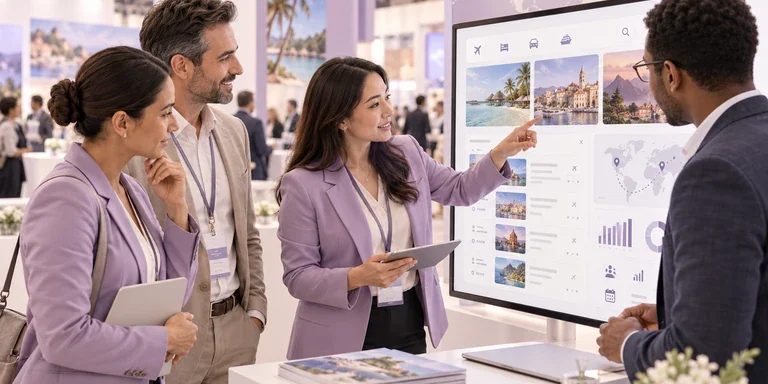
This is one of the strongest reasons for travel agencies and tour operators to attend industry events. Events such as WTM London, Arabian Travel Market in Dubai, Qatar Travel Mart in Doha, Saudi Travel Market, WTM Spotlight Riyadh, ITB Berlin, FITUR in Madrid, ITB Asia in Singapore, ITB India in Mumbai, SATTE in New Delhi, OTM in Mumbai WTM Africa in Cape Town etc. create opportunities to meet partners, explore destinations and discover products. They also give you something that is difficult to find during a normal working day: time to look beyond your own business. You hear how other companies handle familiar challenges. You meet providers you may never have considered. You ask questions, watch demonstrations and begin to recognise where your business could improve. That experience becomes more useful when the people responsible for the work are part of the conversation.
Different departments notice different opportunities
An operations colleague watching a demonstration may immediately recognise a way to simplify itinerary preparation or booking amendments. They know where the delays happen because they deal with them every day. Someone from finance will ask how payments are matched, how refunds are tracked and how much work is needed to reconcile transactions. Those questions can reveal costs and benefits that a sales presentation alone will never explain.Your IT representative can assess how a solution connects with existing systems, how data is protected and what implementation would involve. Marketing may recognise a better way to manage content, follow up on enquiries or understand which campaigns actually lead to bookings. Each department brings a different set of questions, and those questions help the business make better decisions. Giving IT, operations, finance and marketing representatives opportunities to attend relevant events also gives them a voice in improving the way they work.
Take a few real problems with you
A worthwhile event visit starts before you reach the exhibition hall. Ask your team which tasks consume too much time. Where do mistakes keep happening? What frustrates customers? Which reports are difficult to produce? What have you wanted to improve but never found time to investigate? Use those questions to plan your meetings. When a provider demonstrates a solution, ask them to show how it would handle your actual process. Discuss implementation, training, support and the full cost. A polished demonstration deserves a closer look at how the product would work in your business. You do not need to send everyone to every event. Choose the right people for the relevant exhibitors and sessions, then make time afterwards to share what they learned and decide what deserves further evaluation.
Bring the learning back to the office
After an event, it is easy to return to a full inbox and let the brochures, contacts and ideas sit untouched. Set aside time to review them. Identify one or two improvements worth pursuing, give someone responsibility for the next step and assess the likely benefit. Even a modest change that saves a few minutes on a frequently repeated task can make a meaningful difference across the team. And sometimes, exploring the options will confirm that your existing system remains a good fit. That is a useful outcome too: you are making an informed decision. Think back to that television from 2010. You may decide to keep it. But after visiting the showroom, you understand what has changed and what you might be missing.